
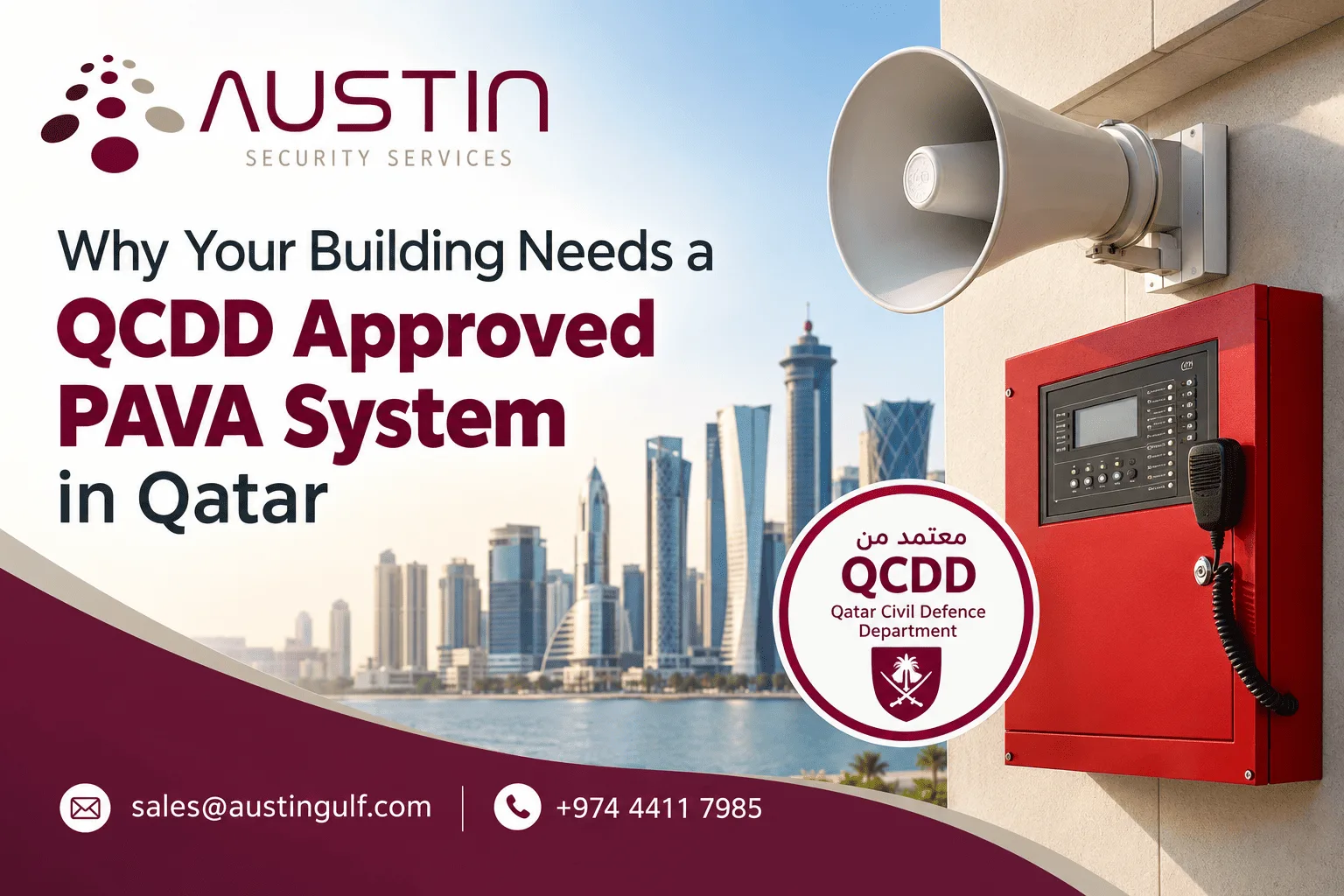
Why Your Building Needs a QCDD Approved PAVA System in Qatar
Why Your Building Needs a QCDD Approved PAVA System in Qatar
A QCDD approved PAVA system Qatar building owners are required to install is one of the most consequential compliance obligations in Qatar’s commercial construction and property management landscape — and one of the most frequently misunderstood. PAVA, which stands for Public Address and Voice Alarm, is not simply a speaker system or a background music platform. It is a life-safety infrastructure mandated by Qatar’s Civil Defence Department for commercial and public buildings of defined occupancy and risk categories, with specific technical standards, commissioning requirements, and ongoing maintenance obligations that apply throughout the building’s operational life.
The Qatar Civil Defence Department, known as QCDD, is the regulatory authority responsible for fire safety and emergency system compliance across Qatar’s built environment. Its mandate covers not only fire suppression and detection systems but the full range of life-safety communications infrastructure — including the voice alarm systems that must notify every building occupant simultaneously and intelligibly in the event of an emergency. A PAVA system that is not designed and installed to QCDD’s specification, or that is installed by a contractor who does not hold QCDD approval, does not satisfy this compliance obligation regardless of the quality of the hardware involved.
This guide explains what a compliant QCDD approved PAVA system Qatar building owners and facilities managers need to commission, what the QCDD’s technical standards demand, why the installer credential matters as much as the system specification, and how Austin Security Services delivers full QCDD PAVA compliance for commercial, institutional, and government premises across Qatar.
Understanding PAVA and the QCDD’s Role in Qatar
Before exploring what a QCDD approved PAVA system Qatar building types require, it is worth being clear about what this infrastructure actually does — because there is significant confusion in Qatar’s market between standard public address systems, background music systems, and the life-safety voice alarm infrastructure that QCDD compliance demands.
A genuine QCDD approved PAVA system Qatar installation is a zoned, intelligible voice alarm platform designed to the EN 54-16 standard for voice alarm control and indicating equipment. It delivers clear, pre-recorded and live voice announcements to defined building zones — enabling evacuation instructions to be directed to specific areas of a premises during an emergency, while other zones continue normal operation or receive different instructions. This zone control capability is fundamental to the QCDD’s life-safety framework, because it allows building managers and emergency services to direct occupants specifically rather than triggering a building-wide alarm that may cause panic or obstruct evacuation in complex multi-floor or multi-zone premises.
The QCDD also requires that PAVA systems integrate with the building’s fire alarm system — so that an automatic fire detection event triggers the appropriate PAVA zone announcements without manual operator intervention, giving occupants the fastest possible evacuation guidance. Austin Security Services designs every QCDD approved PAVA system Qatar installation to this integration standard, ensuring that the PAVA system, fire alarm, and building management infrastructure operate as a unified life-safety platform from day one.
Which Buildings in Qatar Require a QCDD Approved PAVA System
The range of building categories required to install a QCDD approved PAVA system Qatar inspectors enforce is broader than many building owners initially expect, and the list has expanded as Qatar’s construction sector has grown under Vision 2030.
Commercial office buildings above a defined floor area or occupancy threshold, shopping malls and large retail premises, hotels and hospitality properties, hospitals and healthcare facilities, schools and educational campuses, government buildings and public facilities, mixed-use residential and commercial towers, and large industrial and logistics facilities all fall within the QCDD’s mandatory PAVA requirements. The specific threshold at which PAVA becomes mandatory depends on the building’s total area, number of floors, occupancy type, and fire risk classification — all of which are assessed during the QCDD’s initial design review process.
For building owners and developers working on new construction in Qatar, the QCDD’s PAVA requirement is typically identified during the initial fire safety design review — and the system must be designed, specified, and approved by the QCDD before installation begins. For existing buildings being refurbished, repurposed, or brought into compliance following a QCDD inspection, the process involves a site assessment, QCDD design submission, installation by a QCDD-approved contractor, and a final commissioning inspection before the compliance certificate is issued.
What the QCDD’s Technical Standards Demand From a PAVA System
Understanding the specific technical requirements of a QCDD approved PAVA system Qatar specification is essential for any building owner or facilities manager commissioning this infrastructure — because the gap between a specification that meets the QCDD’s standard and one that merely resembles it is significant, and discovering the gap at the commissioning inspection is expensive and time-consuming.
The QCDD requires that PAVA systems are designed and installed to the EN 54-16 standard for voice alarm control equipment and EN 54-24 for loudspeakers. The system must deliver a minimum speech transmission index — a measure of voice intelligibility — meeting the QCDD’s defined threshold in every coverage zone. Speaker coverage and spacing must be calculated to ensure no occupant is beyond the maximum sound level distance for emergency announcements. The system must include backup power capable of maintaining full operation for a defined period following mains power loss — typically two hours of standby plus thirty minutes of full alarm operation. The system must interface directly with the building’s fire detection and alarm system. And the complete system must be commissioned and tested before the QCDD’s inspection, with test results and commissioning documentation submitted as part of the compliance record.
Austin Security Services designs every QCDD approved PAVA system Qatar project to these specific technical standards — using EN 54-certified hardware from manufacturers accepted by Qatar’s QCDD inspection team, and producing the complete commissioning documentation and test results QCDD requires at the compliance inspection stage.
Why the Installer’s QCDD Approval Is as Important as the System Specification
One of the most common compliance mistakes Qatar building owners make with PAVA systems is engaging a contractor who can supply the correct hardware but does not hold formal QCDD approval for fire safety system installation. In Qatar’s regulatory framework, QCDD approval is not simply a mark of quality — it is a legal prerequisite for carrying out fire safety and life-safety system installation on commercial and government premises.
A QCDD approved PAVA system Qatar can only be certified through a QCDD-approved contractor — a system installed by anyone else will not pass the commissioning inspection regardless of equipment quality. The QCDD’s compliance certificate — which building owners require for occupancy certification, insurance coverage, and trade licence compliance — is only issued after a QCDD-approved contractor has certified the installation and the QCDD’s inspector has verified it.
Austin Security Services holds formal QCDD approval and has delivered QCDD approved PAVA system Qatar installations across commercial offices, hotels, schools, and healthcare facilities nationwide. For building owners seeking authoritative guidance on Qatar’s QCDD fire safety compliance requirements, the Qatar Civil Defence Department fire safety compliance requirements page provides detailed regulatory information on life-safety system obligations for commercial and institutional premises across Qatar.
Integration With the Wider Building Security and AV Ecosystem
A QCDD approved PAVA system Qatar installation does not exist in isolation — it is one component of the wider building technology ecosystem that Austin Security Services designs and delivers across all three core service pillars.
PAVA systems work most effectively when integrated with the building’s CCTV surveillance infrastructure — enabling security operations centre teams to simultaneously monitor the premises visually and manage voice alarm communications from a single command environment. Our CCTV systems in Qatar connect with PAVA platforms to create this unified operations picture. Our ELV systems — including structured cabling and network infrastructure — provide the physical backbone that every PAVA system depends on for reliable signal transmission and zone control across the building. And our wider audio video solutions, including video walls, IPTV, and intercom platforms, are designed from the outset to share infrastructure with the PAVA system where specifications permit — reducing redundant cabling and simplifying the building’s overall technology management.
This integrated approach ensures that every QCDD approved PAVA system Qatar project we deliver does not just pass the QCDD commissioning inspection — it performs as part of a building technology ecosystem that is operationally coherent, technically unified, and supported by a single accountable partner for the long term.
Post-Installation Maintenance and Ongoing QCDD Compliance
Installing a compliant QCDD approved PAVA system Qatar marks the beginning of an ongoing compliance obligation. Qatar’s QCDD requires that PAVA systems are regularly tested and maintained throughout the building’s operational life, with records of testing and maintenance available for QCDD inspection at any time.
Austin Security Services provides Annual Maintenance Contracts for every PAVA installation we deliver across Qatar — covering scheduled system testing, loudspeaker performance checks, backup power battery testing and replacement, firmware updates, fire alarm interface verification, and emergency callout response. Our AMC clients maintain full QCDD compliance between inspections and have complete maintenance documentation available at all times.
Contact our team or explore our CCTV systems in Qatar page to learn more about our full audio video and PAVA compliance service offering. Call +974 4411 7985 today to arrange a free PAVA compliance assessment for your Qatar premises.
FAQ
Q1: What is a QCDD approved PAVA system in Qatar?
A: A QCDD approved PAVA system Qatar installation is a Public Address and Voice Alarm system designed and installed to Qatar Civil Defence Department standards — specifically EN 54-16 for voice alarm control equipment and EN 54-24 for loudspeakers. It delivers zoned, intelligible emergency voice announcements to building occupants and integrates directly with the building’s fire alarm system. QCDD approval of both the system specification and the installing contractor is required before any PAVA installation can be certified in Qatar.
Q2: Which buildings in Qatar need a PAVA system?
A: Qatar’s QCDD mandates PAVA system installation for commercial office buildings, shopping malls, hotels, hospitals, schools, government buildings, mixed-use towers, and large industrial facilities above defined occupancy and floor area thresholds. The specific requirement depends on the building’s area, occupancy type, number of floors, and fire risk classification. Austin Security Services conducts free compliance assessments to confirm whether a premises requires a QCDD approved PAVA system Qatar installation.
Q3: What technical standards does a QCDD approved PAVA system in Qatar need to meet?
A: Qatar’s QCDD requires PAVA systems to be designed to EN 54-16 and EN 54-24 standards, achieve minimum speech transmission index levels in all coverage zones, provide backup power for at least two hours standby plus thirty minutes full alarm operation, and integrate directly with the building’s fire detection and alarm system. Austin Security Services designs every QCDD approved PAVA system Qatar installation to these specifications and produces full commissioning documentation for the QCDD inspection.
Q4: Does the PAVA installer need QCDD approval in Qatar?
A: Yes. Installing a PAVA system in Qatar without QCDD contractor approval means the system cannot be certified — regardless of how correctly it is installed or how high the specification. The QCDD’s compliance certificate, which building owners need for occupancy certification and trade licence compliance, is only issued after a QCDD-approved contractor certifies the installation. Austin Security Services holds current QCDD approval and manages the complete commissioning and inspection process on behalf of clients across Qatar.
Q5: Does a PAVA system need to integrate with CCTV in Qatar?
A: While PAVA and CCTV are separate systems with separate compliance frameworks, integrating them delivers significant operational value — enabling security teams to monitor premises visually and manage voice alarm communications from a single command environment. Austin Security Services designs QCDD approved PAVA system Qatar installations to interface with CCTV surveillance infrastructure where specified, creating unified security and life-safety command environments for hotels, hospitals, schools, and corporate premises.
Q6: How do I get a PAVA system installed to QCDD standards in Qatar?
A: Call Austin Security Services at +974 4411 7985 or contact our team to arrange a free compliance assessment. As a QCDD-approved contractor, we will assess your building’s PAVA requirements, manage the full QCDD design submission and approval process, install to EN 54 specification, commission and test the complete system, and coordinate the QCDD inspection to deliver your compliance certificate.


