
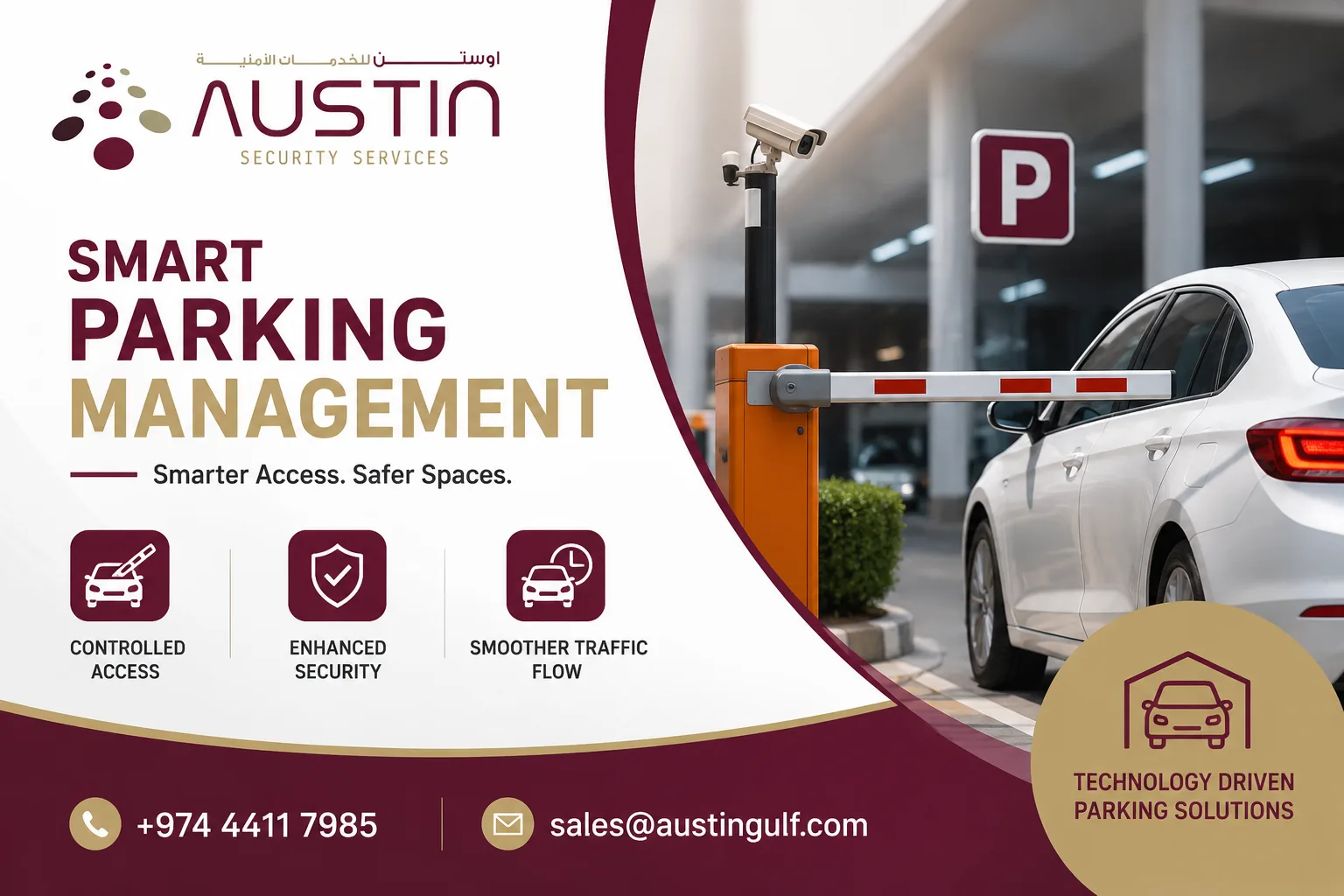
Smart Parking Management: How Technology Is Changing Vehicle Access and Security in Qatar
Smart Parking Management: How Technology Is Changing Vehicle Access and Security in Qatar
Managing parking is no longer simply about providing enough spaces for vehicles. In busy commercial buildings, residential communities, hospitals, hotels and large business facilities, the way vehicles enter, exit and move through a property can have a direct impact on security, traffic flow and daily operations.
As properties become larger and vehicle usage increases, traditional parking methods can become difficult to manage. Manual verification, uncontrolled entry points and inefficient traffic movement can result in delays and create additional responsibilities for security and facility management teams.
This is where modern parking management solutions can make a significant difference.
Why Parking Management Has Become More Important
A parking area is often one of the first points of interaction between a visitor and a property. When vehicle entry is slow or poorly organised, it can create congestion at entrances and affect the overall experience of people using the facility.
At the same time, parking areas need to be considered from a security perspective. Unauthorised vehicles, uncontrolled access and limited monitoring can create challenges for property owners and security teams.
An effective parking management system aims to address both sides of the problem by making vehicle movement more organised while maintaining appropriate access control.
Moving Beyond Manual Parking Management
Traditional parking management often depends heavily on security personnel to check vehicles, identify authorised users and control access. While manual supervision still has an important role, relying entirely on people can become challenging when a property handles a large volume of vehicles.
Technology can reduce some of this workload by introducing automated processes for vehicle access and monitoring.
Instead of treating every vehicle in exactly the same way, modern systems can be designed around the specific requirements of a property. Residents, employees, visitors, service vehicles and other authorised users can be managed according to defined access policies.
This creates a more structured approach to parking management.
How Technology Can Improve Vehicle Movement
One of the biggest advantages of a modern parking management system is improved vehicle flow.
During busy periods, even small delays at an entrance can quickly create a queue. When multiple vehicles are arriving at the same time, efficient access procedures become particularly important.
Automated access systems can help reduce unnecessary delays by making the entry and exit process more organised. This can be particularly useful for properties such as office complexes, residential developments, shopping facilities and hotels where vehicle movement can vary significantly throughout the day.
Better vehicle flow also benefits security personnel because they can focus their attention on situations that require human intervention rather than spending all their time managing routine access.
Parking and Property Security Are Closely Connected
Parking management should not be viewed as a completely separate function from building security.
A parking area can provide access to the wider property. If vehicle entry is not properly controlled, unauthorised individuals may gain easier access to restricted areas.
For this reason, parking systems can be integrated with other security technologies used within a property. Access control, CCTV surveillance and gate barrier systems, for example, can work together as part of a broader security infrastructure.
This integrated approach can give facility managers better visibility and control over vehicle access.
Different Properties Need Different Approaches
There is no single parking management solution that works equally well for every property.
A residential community may need to manage resident vehicles and visitors, while a corporate building may need to control employee and guest access. A hospital may have additional requirements for emergency vehicles, patients and service providers.
The physical layout of the property also matters.
The number of entry and exit points, parking capacity, traffic volume and operating hours can all influence how a parking management system should be planned.
Before selecting a solution, property owners and facility managers should therefore consider the actual movement of vehicles within their premises rather than choosing technology based only on individual features.
The Role of Automation in Modern Parking Facilities
Automation is becoming increasingly important across building management and security operations. Parking is one area where automation can provide practical benefits without completely replacing human supervision.
Automated systems can help handle routine access processes while security personnel remain responsible for monitoring the facility and responding to unusual situations.
This balance between technology and human oversight can make parking operations more efficient while maintaining appropriate security procedures.
What Should Businesses Consider Before Installing a Parking System?
Choosing a parking management solution requires more than selecting equipment. The system should be suitable for the property’s current requirements and capable of supporting future changes.
Some important considerations include:
Traffic volume: How many vehicles enter and leave the property during peak hours?
Access requirements: Who should have access to the parking facility?
Property layout: Where are the entrances, exits and restricted areas located?
Security needs: How does parking access connect with the property’s wider security system?
Scalability: Can the system accommodate additional vehicles, parking areas or access points in the future?
Maintenance: Is there reliable technical support available to keep the system operating properly?
Considering these factors at the planning stage can help prevent operational difficulties later.
Parking Management in Qatar
Qatar has a wide range of commercial, residential, hospitality and infrastructure developments where efficient vehicle management is an important operational requirement. As properties continue to adopt technology based security and building management systems, parking management is becoming an increasingly relevant part of modern facility planning.
For property owners and facility managers, the objective is not simply to control vehicles. It is to create a parking environment where access is organised, security is maintained and daily vehicle movement can take place with fewer unnecessary delays.
Companies such as Austin Security Services provide parking management and other ELV solutions in Qatar, helping businesses and property operators implement technology based systems according to their specific requirements.
A More Organised Approach to Parking
Good parking management is ultimately about more than parking spaces. It involves understanding how people, vehicles, security teams and technology interact within a property.
As vehicle volumes increase and properties become more technology driven, automated parking management can help create a more organised approach to vehicle access.
For businesses and property owners in Qatar, the right solution should be selected based on the property’s layout, traffic patterns, security requirements and future needs. With proper planning and professional implementation, parking management can become an important part of a property’s overall security and operational strategy.


